Thanks Dr. Lou and classmates for another good and learning-field semester.
Two things:
“Learning is a personal and social process. It is acquiring new set of knowledge, skills, values, or preferences. Learning is achieved when experienced and applied. Learning outcome is the adaptation of the new knowledge to shared purposes, situations, and environments.”
“The best teacher will make an impact. Teaching and curriculum design that understands how students learn optimizes effective learning. The different learning theories allow teachers to make sense of the spectrum of teaching methods and select the most appropriate tools to secure deep and life-long learning.”
Constructivism is a theory about how people learn. People construct their own understanding and knowledge of the world, through experiencing things and reflecting on those experiences. When one encounters something new, he reconciles it with his previous ideas and experiences, it can change what he believes or it can discard the new information as irrelevant. In any case, people are active creators of their own knowledge. To do this, they must ask questions, explore, and assess what they know.
The constructivist culture sounds great in theory, but what does it actually look like in our classrooms? It can point towards a number of different teaching practices. Generally, it means encouraging students to use active techniques (experiments, real-world problem solving) to create more knowledge, reflect, and talk about what they are doing and how their understanding is changing. The teacher makes sure he understands the students’ preexisting conceptions, and guides the activity to address them and then build on them.
To foster a constructivist environment is to simply adjust our mindset during the planning process. Instead of creating every project, activity or assignment from beginning to end, teachers should define a backbone of expectations and let their students fill in the rest. Teachers should guide students along the way, but the students should be in the driver’s seat. Teacher needs to cultivate the power of the process. Teachers’ role shifts from deliverer of information and knowledge to facilitator of experiences. A successful constructivist learning environment is all about authenticity. Teachers get a higher level of student involvement when a task or project is real-world and authentic.
One of the problems that is frequently highlighted in classroom is the “spoon-feeding” technique used by the teachers.
Two types of spoon-feeding
I learned that there are two types of spoon-feeding. One is Explicit such as providing review materials to students to “pass” an exam. This happens in the classroom, to “merely pass the exam”. This is also common to most review centers, where, answers are being provided, not merely the concepts. Another type is Implicit that includes the teacher-centered learning approach. The teachers model and guide the students to know and do what they need to.
Implicit spoon-feeding is scaffolding in the works and is of advantage when the teacher knows when to stop the process. It is a powerful tool in teaching-learning processes as it allows students to build confidence and helps them tackle more difficult tasks.
What are the limitations of Spoon-feeding?
Spoon-feeding does not stimulate active participation from the students and only fosters rote learning.
Spoon-feeding does not promote independent learning and creativity.
Students lack initiative and problem-solving skills because they have not been trained to search for data by themselves.
What are the alternatives to Spoon-feeding?
The main paradigm shift is to put responsibility for learning on the students themselves and to ask teachers to train students to find the answers to their enquiries by themselves, using learning resources. The focus of teaching is to train students to assess their own educational needs, to search for relevant information, and to develop their own critical thinking and problem-solving skills.
All educators want students to succeed but not to the point that “Success” is hand-overed instead of the students earning it.
Spoon-feeding results to the death of creative and critical thinking. In the long run, its harmful effect can lead to poor performance once the student becomes adult. How a person who has been spoon-fed his whole life fares in his career? Spoon feeding must be stopped in the classroom.
I always thought that multi-tasking places me to my advantage. As a corporate employee, I accomplish several tasks and submit projects on time. As a teacher and a trainer, multi-tasking is a way of life.
I always thought that multi-tasking is a plus. “Doing several things at the same time” is skill that not everyone can master. But constantly performing several tasks at once can lead to a drop in productivity. The bad effects of multitasking take their toll by not allowing you to recover from excessive stimulation that bombards you on a daily basis.
Consequences of multi-tasking
I came across the following cons towards multi-tasking:
You’re more likely to produce errors. When you aren’t giving a task your full attention, then mistakes may occur that you’re less likely to catch.
Your stress levels may increase. Multitasking means overloading your brain with stimuli and commands. That creates stress, and may even lead to health consequences.
You’re probably going to miss noticing additional items. If your brain is already overloaded with multiple tasks, then it’s far less likely to take in additional information that you weren’t looking for.
Your memory of the work and events may be reduced. Switching back and forth causes a reduction in our brain’s ability to fully encode our experiences, so our memories of multi tasked events grow blurry.
You’re hurting any possible interpersonal interactions around you. Trying to multitask – especially if it involves looking at screens – means that you’re less engaged in the relationships around you. Effective face-to-face interactions take time and focus, but are ineffective when you’re only giving partial attention.
Your creativity is diminished. Your brain has little opportunity to come up with spontaneous, “aha” moments of insight when it’s already overloaded with multiple responsibilities. It’s far less likely that you’ll generate good, original ideas if you’re focusing on more than one thing.
Your IQ actually decreases. Yes, research says that since there’s less cognitive power devoted to individual tasks, your actual intelligence quotient diminishes while multitasking. So if the work you produced while multitasking seems dumber, it’s because you literally were dumber while working.
With these realities, I can only manage my multi tasking better by making a to-do list, work on related tasks, delagate tasks if I can, and take a break.
Imposing higher cognitive load on myself requires several cognitive functions, different types of attention, working memory and executive functions; which can be dangerous to my mental health.
When faced with a challenge, do you feel like you can accomplish your goal or do you give up in defeat?
Do you sometimes doubt your abilities to overcome difficulties or do you always believe in yourself that you can rise up?
Are you a victim or a survivor?
These are just some of the questions that popped out my head when reading about Self Efficacy. This topic is so practical and relatable that I can only think of where self confidence and the lack of it is also placed.
The concept of self-efficacy is introduced by Albert Bandura in his Social Cognitive theory which emphasizes the role of observational learning, social experience, and reciprocal determinism in developing a personality. According to him, self-efficacy is “the belief in one’s capabilities to organize and execute the courses of action required to manage prospective situations.” In other words, self-efficacy is a person’s belief in his or her ability to succeed in a particular situation. Bandura described these beliefs as determinants of how people think, behave, and feel.
Too many has being said about self-efficacy and I know now that it is important, so important that it ranks higher than talent. What is talent if you don’t have the proper mindset, motivation, and will to carry out this given gift? They say self efficacy is a recipe for success. If it is so, the we must pay special attention to it when setting goals and make sure that our beliefs are in line with our goals.
Gandhi perfectly understood the pivotal role that self-belief plays in our lives:
Your beliefs become your thoughts. Your thoughts become your words. Your words become your actions. Your actions become your habits. Your habits become your values. Your values become your destiny.
One of the Behaviorist assumptions is that, learning is manifested by a change in behavior. This is very practical. You encounter something new, you understand the situation, you adapted it, and you alter your behavior. That’s learning
Another is that, the environment shapes behavior. I can only think of how people (modelling), teaching materials, technology tools, learning resources, curriculum, training, instruction, and the learning space affects one’s learning.
Lastly, Guthrie’s contiguity theory specifies that “a combination of stimuli which has accompanied a movement will on its recurrence tend to be followed by that movement”. This assumption that all learning was a consequence of association between a particular stimulus and response makes me think of how advertisements greatly impact the individual behavior and society.
Behaviorism focuses on the observable behavior which they claim must be the subject of a scientific study. Although this type of study will yield measurable results, and can be applicable to a number of cases, such as in treatments for human disorders including autism, anxiety disorders and antisocial behavior, it fails to account for the learning process and how the mind and the affective domain interfere in the processing of information.
In the end, behaviorists convinced me of their theories, but there still a side of it that is missing. Behaviorism does not account for free will and internal influences such as moods, thoughts, and feelings. It doesn’t take into account important internal processes that take place in the mind. There are many instances of learning that occurs without the use of reinforcements or punishments. Behaviorists focus on the target, desirable behavior, that is the product. They fail to explain how humans learn, the process through which the learning takes place. I think these things are very crucial, and we need more explanation.
One form of Intelligence that I haven’t thought of or known before is Spiritual Intelligence.
At first, I thought of Spiritual Intelligence as synonymous to the “spiritual” gift that the pastors or preachers in our church possess. Since being “spiritual” almost always relates to religion or religious beliefs, I thought of this Spiritual intelligence as something with divinity or omnipotence.
As Wikipedia defines it, Spiritual intelligence is a term used by some philosophers, psychologists, and developmental theorists to indicate spiritual parallels with IQ (Intelligence Quotient) and EQ (Emotional Quotient). Howard Gardner, the originator of the theory of multiple intelligences, chose not to include spiritual intelligence amongst his “intelligences” due to the challenge of codifying quantifiable scientific criteria. Instead, Gardner suggested an “existential intelligence” as viable. However, contemporary researchers continue to explore the viability of Spiritual Intelligence (often abbreviated as “SQ”) and to create tools for measuring and developing it. So far, measurement of spiritual intelligence has tended to rely on self-assessment instruments which some claim can be susceptible to false reporting.
It was Danah Zohar in 1997 who coined the term “Spiritual Intelligence” and defined the 12 principles underlying it. These 12 principles are: Self-awareness, Spontaneity, Being vision- and value-led, Holism, Compassion, Celebration of diversity, Field independence, Humility, Tendency to ask fundamental “Why?” questions, Positive use of adversity, Ability to reframe, and Sense of vocation.
I realized from the class assignment that spiritual Intelligence is a higher dimension of intelligence that activates the qualities and capabilities of the authentic self in the form of wisdom, compassion, integrity, joy, love, creativity, and peace. Spiritual intelligence results in a sense of deeper meaning and purpose, combined with improvements in a wide range of important life skills and work skills.
Knowing these, I reflected on the spiritually-intelligent people that I have encountered in my life. This may sound personal, but I have thought of influences in my life like my grandmother, parents, and aunt who, I think, are the most spiritual intelligent people that I know. My grandmother and aunt may not have graduated High School and they claim that they have low IQ, (again, the old-school standards of intelligence) but for me they have a deep sense of meaning, vision, and values.
Have you ever thought that you’re not intelligent enough to do something? That you’re not as intelligent as another person so you can’t succeed like they have?
I have so many questions reflecting on the concept of intelligence and if it is really an indicator of one’s success.
This led me to define Intelligence first. I will quote Wikipedia, and it says: Intelligence has been defined in many ways, including: the capacity for logic, understanding, self-awareness, learning, emotional knowledge, reasoning, planning, creativity, critical thinking, and problem solving. More generally, it can be described as the ability to perceive or infer information, and to retain it as knowledge to be applied towards adaptive behaviors within an environment or context.
The definition is so broad and complex. It did not help me a lot.
One of my whims about our system is the delineation it creates between ‘intelligent’ and ‘non-intelligent’. Since childhood, I hear people regard students who have high grades in school as ‘intelligent’; and students who get a “line of 70” or “palakol” as “Bobo”. I seldom hear people compliment athletes who champed on their specific fields, or praise artists who captured hearts with their masterpieces, or commend school singers and dancers for a breath-taking performance. Nobody would call them intelligent, instead people would advise that they should also do well in class. Meaning, they should get high grades, because higher grade is to equal to high IQ, high IQ equals to Intelligence.
I am thankful of Gardner’s theory of multiple intelligence. By his acknowledgement of nine unique forms of intelligence, I can explain to the younger generation that “Grades” are not the only indicator of “intelligence”, and that you are not “Bobo”.
Let me enumerate those multiple forms of intelligence according to Howard Gardner.
Naturalistic intelligence – intelligence of the natural world
Musical intelligence – talent for identifying sound, pitch, rhythm, and timbre
Logical-mathematical intelligence – the use deductive analysis, logical reasoning, and executive planning to your advantage
Existential intelligence – philosophical mind, abstract concept and theory
Learning happens so often that you don’t notice it is actually happening.
But really, what is learning? I will attempt to define it based on my own understanding, for sure I’ll miss out on many scholarly definitions, and that is for me (for you) to find out by the end of the the semester (EDS_Theories of Learning).
Learning for me is acquired. Learning is acquiring new set of knowledge, skills, values, or preferences. They are chunks of concept or idea that fill your memory and use your multiple senses. These chunks are fully understood when you relate them to other knowledge.
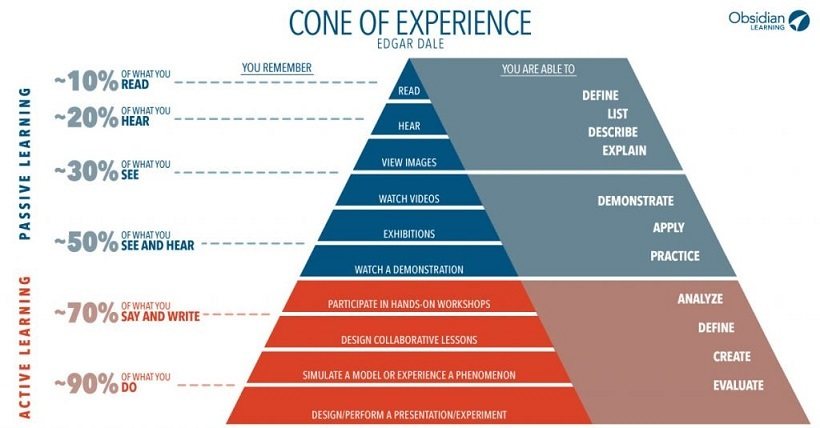
Learning is achieved when experienced and applied. That’s why they say that experience is the best teacher. What good is knowing something without application? In the learning pyramid of Edgar Dale, it says that we learn 80% if we personally experience.
Learning is the adaptation of these new concepts and ideas to different purposes, situations, and environments. If one has the ability to apply and “teach” the “what” and the “know-how” to a variety of circumstances, then that is “Real learning”.
Learning is an ongoing process. It is a cycle that occurs consciously or without conscious awareness.





 MM Exclusive