Final thoughts

Let me go back to my first entry entitled “Assessment literacy is essential for teachers”. I still hold that we need to promote further education and training, or maybe a refresher, to our teachers and educators about the impact of Assessment. Assessment constitutes an essential component of any educational process, however, many teachers, educators, seem to ignore its multiple implications and manifestations.

We all know that results from assessments can be very high stakes, affecting the life chances of the students and those who are involved. Impact can also affect educational decisions and policies. Our assessments are monitored for quality during their development and when they are operational to check that they are fit for purpose and that they deliver their intended consequences.

Comprehensive, balanced, and quality assessment systems have the potential to support the teaching and learning process. Providing teachers with the skills, knowledge, and expertise to be assessment literate is one piece to educational excellence. The time is long overdue to replace silos with systems that require collaboration, communication, and critical thinking.

What types of feedback are there?

I have worked as a quality specialist in a BPO and giving and providing feedback to employees is a daily thing. I have noticed that although the task is the same, and some of the results are the same, there is really no similar experience in terms of providing feedback because of individual differences. Usually, the word feedback connotes a negative feeling thus, even before it is delivered, there is already a prejudice on the part of the employees.

The type of feedback given to employees has a major impact on their performance.

What are the types of feedback in the work place?

Constructive feedback is information specific, issue-focused and based on observation. Constructive feedback can be Negative which is corrective in nature and focuses on behavior or task that should not be repeated. It can also be Positive which affirms and encourages good behavior or task that was successful and can be repeated.

There is also what we call Praise feedback that provides positive statements about the person’s behavior/task. Most employees will respond to praise with an increase in self-esteem, self-efficacy and/or confidence.

Criticism on the other hand is a negative statement about their behavior/task. Criticism is destructive feedback and is generally not effective at increasing performance in the workplace as it may lessen employee’s confidence at work. However, this is crucial in a corporate set up and should be delivered no matter what. This impacts company’s over-all performance.

These feedback are given on a one-on-one sessions and supported by written documents.

Note that employees have also metrics that they need to achieve. It is is similar to having the learning objectives in the school setup.

What are the types of feedback in the classroom?

Giving students feedback in the classroom during the learning process has been proven to increase learning and improve student outcomes. When given correctly, feedback guides the student in their learning process and gives them the direction they need to reach the target or goal of the lesson.

Descriptive feedback is intended to tell the learner what needs to be improved. Its goal is to improve student achievement by telling the learner how to move forward in the learning process.

Evaluative feedback is intended to summarize student achievement. Its goal is to measure student achievement with a score or a grade.

Motivational feedback is intended to encourage and support the learner. Its goal is to make the learner feel good.

Feedback during learning allows students to take feedback on board immediately and to try to realize improvement during the learning process. This is often more effective and productive to the learning experience than end-of task feedback measures (usually summative), which require students to remember the feedback and apply the recommended strategies to a future task.

Too often Feedback after learning is not used by the students to improve their work. This often results in teachers making the same comments over and over again and wondering why the student has not transferred the information to another context. For such feedback to influence subsequent learning, students must remember it, translate it into advice that is transferable across tasks, and apply it the next time they encounter a task in which this learning could apply. Generally, while strong students can often do this, struggling students find it more difficult.

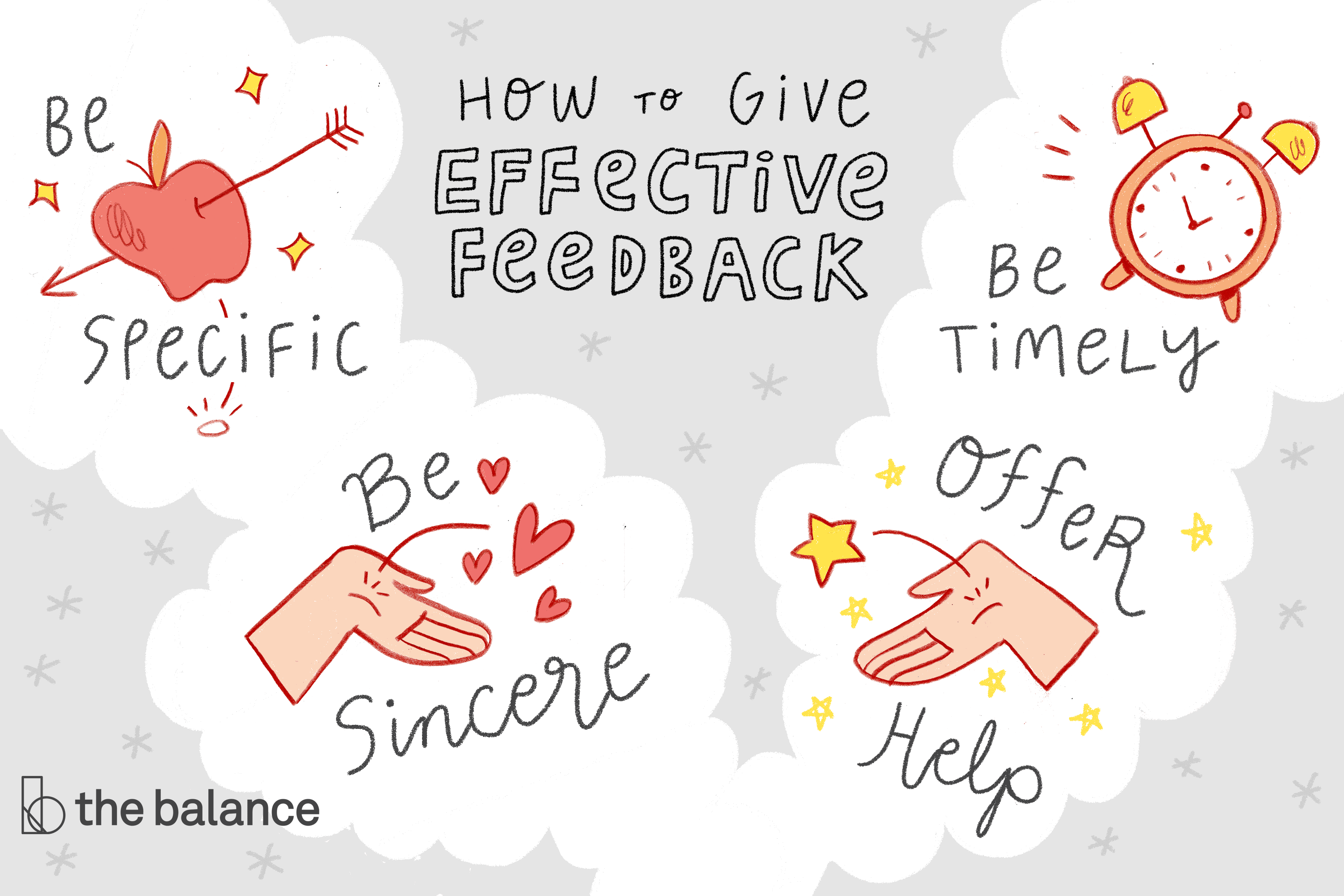
Effective feedback, whether you are giving it to employees or to students has four basic characteristics. It should be timely, targeted, tangible and tied to goals.

Timely feedback provides an ongoing information on how the employees/students are doing and how close they are to their goals. Thus, in order for feedback to be effective, it must be given PRIOR to being evaluated so that they have a chance to make adjustments, corrections, or complete changes to their performance and get closer to their ultimate goals.

Targeted feedback points to specific actions or behaviors and these have effect on reaching the employees/students’ ultimate goal or outcome.

Tangible feedback is focused on things we can actually do something about. It is actionable.

Feedback needs to have a clear connection to the professional and or learning goal and needs to show employees or students how close they are to achieving that goal and point them to the best next steps they need to take in order to achieve that goal.

References:

https://www.talkdesk.com/blog/types-and-sources-of-feedback-in-the-workplace/
http://www.ssgt.nsw.edu.au/documents/1types_feedback.pdf
https://cirt.gcu.edu/teaching3/tips/effectivefeed
https://mindstepsinc.com/2015/11/what-is-effective-feedback/

Constructivism as a Paradigm for Teaching and Learning

As a former teacher and trainer, I was (and still) an avid fan of constructivism approach and share the constructivists’ view in terms of teaching and learning. It is believed that we construct our own understanding and knowledge of the world through experiencing things and reflecting on our experiences. When we encounter something new, we reconcile it with our previous ideas and experiences, they may change our beliefs, or discard the new information as irrelevant. In any case, we are active creators of our own knowledge. To do this, we must ask questions, explore, and assess what we know.

The constructivist view of learning can point towards several different teaching practices. It usually means encouraging students to use active techniques (experiments, real-world problem solving) to create more knowledge and then to reflect on and talk about what they are doing and how their understanding is changing. The teacher makes sure she understands the students’ preexisting conceptions and guides the activity to address them and then build on them.


What is Constructivism?

Constructivism is basically a theory — based on observation and scientific study — about how people learn.

There are many flavors of constructivism, but one prominent theorist is Jean Piaget, who focused on how humans make meaning in relation to the interaction between their experiences and their ideas.

Constructivism as a paradigm or worldview posits that learning is an active, constructive process. The learner is an information constructor. People actively construct or create their own subjective representations of objective reality. New information is linked to the prior knowledge, thus mental representations are subjective.

Constructivist approach to assessment is a formative rather than a summative. Its purpose is to improve the quality of student learning, not merely to provide evidence for evaluating or grading students. Assessment must respond to the needs and characteristics of the teachers and students.

Three constructs emerge from the literature regarding constructivism and have implications for the learning environment. They are (1) learning is an active process, (2) the learner has prior knowledge, and (3) the learner takes responsibility for their own learning (Yager, 1991; Cobb et al 1992, Magoon, 1977; Hewson & Hewson, 1988).

Learning is an active process

Students learn more effectively when they are active during the learning process. They need to react and respond, perhaps outwardly, perhaps only inwardly, emotionally, or intellectually. But if learning is a process of changing behavior, clearly that process must be an active one.

The learner has prior knowledge

Prior knowledge is the knowledge the learner already has before they meet new information. A learner’s understanding of a text can be improved by activating their prior knowledge before dealing with the text, and developing this habit is good learner training for them.

The learner takes responsibility for their own learning

When students understand their role as agent (the one in charge) over their own feeling, thinking and learning behaviors, they are more likely to take responsibility for their learning. To be autonomous learners, however, students need to have some actual choice and control.

What are the benefits of constructivism?

  • Students learn more, and enjoy learning more when they are actively involved, rather than passive listeners.
  • Education works best when it concentrates on thinking and understanding, rather than on rote memorization. Constructivism concentrates on learning how to think and understand.
  • Constructivist learning is transferable. In constructivist classrooms, students create organizing principles that they can take with them to other learning settings.
  • Constructivism gives students ownership of what they learn, since learning is based on students’ questions and explorations, and often the students have a hand in designing the assessments as well. Constructivist assessment engages the students’ initiatives and personal investments in their journals, research reports, physical models, and artistic representations. Engaging the creative instincts develops students’ abilities to express knowledge through a variety of ways. The students are also more likely to retain and transfer the new knowledge to real life.
  • By grounding learning activities in an authentic, real-world context, constructivism stimulates and engages students. Students in constructivist classrooms learn to question things and to apply their natural curiosity to the world.
  • Constructivism promotes social and communication skills by creating a classroom environment that emphasizes collaboration and exchange of ideas. Students must learn how to articulate their ideas clearly as well as to collaborate on tasks effectively by sharing in group projects. Students must therefore exchange ideas and so must learn to “negotiate” with others and to evaluate their contributions in a socially acceptable manner. This is essential to success in the real world, since they will always be exposed to a variety of experiences in which they will have to cooperate and navigate among the ideas of others.

Readings and Sources:

https://www.thirteen.org/edonline/concept2class/constructivism/
https://www.learning-theories.com/constructivism.html
https://en.wikipedia.org/wiki/Constructivism_(philosophy_of_education)
http://www.iqst.upol.cz/e-learning/m1/e-learning-m1-u2.php
https://www.teachingenglish.org.uk/article/prior-knowledge
https://www.apa.org/education/k12/learners
https://www.funderstanding.com/theory/constructivism/

Dr. Bloom and I

I have noted in my e Journal for module 1 of this course the importance of assessment literacy for teachers or educators. And there I also shared about my journey as a “clueless'”, non-education graduate, and a first-time college teacher. I knew then about the learning goals and that they should be achieved at the end of the semester. And so, I thought of learning strategies to make sure goals will be met, but little did I know that the assessment method should also be aligned with the teaching strategy and the goals. I may have performed my responsibility to impart the necessary knowledge and skills to my students, by my measure is not really aligned and so I was not able to tell if learning has occurred and if the objectives are met.

I was thankful then that my colleagues (veterans in their profession) were so supportive of me and helped me in my dilemma. I may have failed in my first exam as a teacher, but I was able to bounce back towards the end. At that point, I truly appreciated the value of formative assessment. Formative assessment is a tool to find out what the students know and can do and to identify the gaps and opportunities for the class and for each individual learner. It provides immediate feedback that can help in deciding which instructional strategies and resources to use to facilitate learning. Teachers use assessment FOR learning to enhance student’s motivation and commitment to learning. I can say that more than my students, I have learned and gained in the teaching-learning process.

The next best thing that happened was, Dr. Benjamin Bloom and I became the best of friends.

What is Bloom’s taxonomy?

Bloom’s Taxonomy is a classification of the different objectives and skills that educators set for their students (learning objectives). The taxonomy was proposed in 1956 by Dr. Benjamin Bloom, an educational psychologist at the University of Chicago. The terminology has been recently updated to include the following six levels of learning. These 6 levels can be used to structure the learning objectives, lessons, and assessments of your course.

  1. Knowledge (Remembering): Retrieving, recognizing, and recalling relevant knowledge from long‐term memory.
  2. Comprehension (Understanding): Constructing meaning from oral, written, and graphic messages through interpreting, exemplifying, classifying, summarizing, inferring, comparing, and explaining.
  3. Application: Carrying out or using a procedure for executing or implementing.
  4. Analysis: Breaking material into constituent parts, determining how the parts relate to one another and to an overall structure or purpose through differentiating, organizing, and attributing.
  5. Evaluation: Making judgments based on criteria and standards through checking and critiquing.
  6. Synthesis (Creating): Putting elements together to form a coherent or functional whole; reorganizing elements into a new pattern or structure through generating, planning, or producing.

Bloom’s and learning objectives

 Bloom’s and assessment guide

With these mighty guide, I was able to pull off and aligned the course objectives with my teaching strategy and assessment method. This is how the teaching and learning process should be. But of course, it doesn’t end in the classroom.

References:

Assessment is a constant cycle

Whether one is assessing student learning outcome (SLO), course objectives, course programs, or teacher’s facilitating methods, it is important to note that assessment cycle comes into play. It is a process that intends to provide a meaningful feedback.

The first phase in the cycle is Identifying needs. Did you remember taking a test before entering high school or before taking a course? Or answering pre-training test at work? That is a diagnostic test. This form of assessment is given before the instruction or training begins. Its purpose is to identify current skills and learning preferences that includes resources and equipment. This is also true in the institutional level. The results lead you to the next phase.

Planning learning is an important aspect in the assessment cycle. This is where the curricula are born; the course programs are drafted; and the syllabi are created. This is a logical flow of the elements in the classroom that a teacher or a trainer needs to deliver. What are the subjects or topics to convey over a period of time? How should it be delivered? What are the activities that can engage learning? How to assess learning? This whole scheme is thought of carefully to ensure a meaningful SLO.

Next is Facilitating learning. I think that this is the most crucial part because this materializes or fails the teaching and learning plan. This is the actual teacher’s battle as he faces the different factors that affect the learning process. These factors are the students Intellectual, Physical, Emotional and Social state, and Environmental condition. Teacher’s personality is also a factor that can motivate learning or otherwise.

Teaching effectiveness is a great consideration in this phase. Sometimes, the preparation of teachers for specific age levels, specific subject matter, specific academic skills, etc., is not sufficient against the diversity of the learners. There is a strong need to train teachers to adapt instruction to the diverse student abilities, learning styles, personality traits and needs by using more differentiated teaching strategies.

Next is, Assessing learning. Assessing learning is a must. It can be informal like repeatedly asking students understanding such as in recitations (graded or  not), giving out quizzes, discussing questions, or letting them perform an activity based on the lessons. Formal assessments can be in a form of an examination, case study, or a project that has to be completed based on the class requirements. Assessment methods are the strategies, techniques, tools and instruments for collecting information to determine the extent to which students demonstrate desired learning outcomes. Several methods should be used to assess student learning outcomes. There are various methods that can be utilized to assess SLO. On the onset, this confirms students learning and determine if the teaching strategies are effective.

Now comes the fifth phase in the cycle which is Evaluating learning. This includes the evidence of students learning as well as institutional performance indicators. Is the student learning outcome (SLO) meaningful? Are the course objectives have been met? Are the course programs appropriate? Is there a need to change policies and practices? Is there a problem identified? What is the root cause of this problem? The analysis leads back to the first phase which is again, identifying the actual needs.

The different possibilities of implementing changes and approaches can be very beneficial and can have significant positive effects on the teaching and learning process in our education system.

With the rapid changes and increased complexity of our education system, there is a continuous challenge to improve the education plan and meet the needs of the more demanding learners.

References:

Teaching, learning and assessment cycle (Ann Gravells, 2016) [YouTube] https://www.lanecc.edu/assessment/basic-assessment-cycle https://www.wssu.edu/about/assessment-and-research/niloa/_files/documents/assessmentmethods.pdf

Assessment literacy is essential for teachers

I started as a university teacher and eventually became a trainer in a corporation. Though academe and corporate are two different settings, my goal is the same : to impart knowledge and make sure that this knowledge is truly understood and applied.

Easier said, isn’t it?

Fresh from my bachelor’s degree, I embarked on a journey that I was clueless at first. All I know is that, I have to teach different subjects to diverse students at a given set of time. It is more of a job than a vocation. I only learned of teaching methods and techniques as  I perform them in class. I only met Benjamin Bloom as I create syllabi for my subjects. I only discovered that curriculum, instruction,  and assessment are close ties as I prepare exams for my students. For the most part, I performed my “job” based on my personal experiences, from the way my former teachers handled our class, to the type of assessment my learning has been measured.

I am not an Education graduate, I don’t’ know anything about its principles. I realized then the importance of literacy in teaching, and how education concepts affect teaching and learning.

It is true that instruction methods play a vital role in the learning process, but how can we measure its effectiveness? How do we know if the students are learning the things that they are supposed to learn? Assessment is a tool in determining the answers.

What is Assessment?

  • Assessment is the process of documenting knowledge, skills, attitudes and beliefs, usually in measurable terms. The goal of assessment is to make improvements, as opposed to simply being judged. In an educational context, assessment is the process of describing, collecting, recording, scoring, and interpreting information about learning. (“Differences between Testing, Assessment, and Evaluation”, http://tutorials.istudy.psu.edu/testing/testing2.html)
  • In the context of institutional accountability, assessments are undertaken to determine the principal’s performance, effectiveness of schools, etc. In the context of school reform, assessment is an essential tool for evaluating the effectiveness of changes in the teaching-learning process. (“Assessment Terminology: A Glossary of Useful Terms”, http://www.newhorizons.org/strategies/assess/terminology.htm)
  • Assessment is an integral part of instruction, as it determines whether or not the goals of education are being met. Assessment affects decisions about grades, placement, advancement, instructional needs, curriculum, and, in some cases, funding (Why Is Assessment Important?, https://www.edutopia.org/assessment-guide-importance)


What is Assessment literacy?

With the greater role of assessment in education, I believe that assessment literacy is essential for teachers. Assessment literacy is the possession of knowledge about the basic principles of sound assessment practice, including terminology, the development and use of assessment methodologies and techniques, familiarity with standards of quality in assessment. Increasingly, familiarity with alternatives to traditional measurements of learning. (Assessment Terminology: A Glossary of Useful Terms”, http://www.newhorizons.org/strategies/assess/terminology.htm)

But Assessment is not limited to knowing students learning.

Assessment literacy is a term which was first coined by Richard Stiggins (1991). He notes that educators with assessment literacy know what they assess, why they assess, how to assess, what the possible problems with assessment are, and how to prevent them from occurring.

Norman Webb (2002) says that Assessment Literacy is defined as the knowledge about how to assess what students know and can do, interpret the results of these assessments, and apply these results to improve student learning and program effectiveness.”

According to Stiggins (2002), these are the teacher competences for assessment:

  • Connecting assessments to clear purposes
  • Clarifying achievement expectations
  • Applying proper assessment methods
  • Developing quality assessment exercises scoring criteria and appropriate sampling
  • Avoiding bias in assessment
  • Communicating effectively about student achievement
  • Using assessment as an instructional intervention

Klenowski (2011) argues that ‘to raise the assessment literacy of teachers there is a need to understand, and practice, the fundamental principles of assessment design’, including fitness for purpose and positive contribution to learning’.

We need assessment literate teachers

Assessment literacy is essential for teachers. This is not just to ensure student learning. By now, we know that a good assessment can empower the teachers themselves to better carry out their role in education. Assessment can improve teaching and learning, and put activities and behaviors in place.

References: